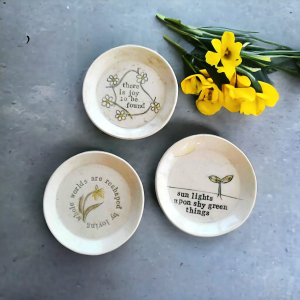
We often gets asked when at fairs or pop-up shops, what comes first? The poetry or the pottery? The answer is always, it depends…
The whole style that we have developed started with the poetry, which Chris has written since he was a child. I (Michaela) started having a go at pottery, first making decorations, beads, little landscapes.. But I wanted away to put one of Chris’s poems that I really loved on display and wondered if it would be possible on clay. And it worked. And the whole thing grew..
We both do pottery now, but to start with it was just me. I would make the shape, for example a bowl, a jug, or a slab of clay for creating an artwork on, then choose a poem to put on the clay, or part of a poem. I will decide where the words will go – inside or outside, flowing around the top or down the sides, depending on how I want the words to be portrayed on the clay.
Following this comes the imagery, which can be sketched in to the clay or by adding colour and texture with underglazes or glazes playing their part too.
Hopefully, each element is equally treated and the whole thing comes together, like on this pot, with the words, will the river run forever, sparkling with the splash of light and life..?
Yesterday, a friend called in the pottery and she said I like what you are making, and I said, oh, Chris made them, I’m just putting the poetry on them, and she challenged me on that and I think she was right. It’s all an important part, in whatever order it happens.
https://seatreeargyll.com/wp-content/uploads/2024/04/seatree_logo_transparent-1030x210.png00Michaela Goanhttps://seatreeargyll.com/wp-content/uploads/2024/04/seatree_logo_transparent-1030x210.pngMichaela Goan2025-02-05 19:10:092025-02-05 19:10:09What comes first, the poem or the pot?
A post from Chris, reflecting on the evolution of some of the seatree elemental pieces.
Over the past few years I have been grappling with a new craft. Even though we have run a business making pottery for about a decade, Michaela was the potter really whilst just worked around the edges, helping out with some of the donkey work. My areas of creativity were outside the use of actual clay. Then it all changed.
First, I began working with a different clay body- with much more ‘grog’ mixed in (ground down fired clay.) This was much more forgiving than the white stoneware clay that Michaela loves so much, more plastic and willing to hold shape – or at least I think so. Michaela might protest. These qualities of the grogged clay mean that building bigger vessels is that bit easier, but also this kind of clay also has the capacity to cope with so much more thermal shock, meaning that alternative firing methods are possible… so I started making big old pots and trying to fire them in pits dug in the garden, with mixed success!
Then I discovered raku.
Time for a short introduction to clay firing.Most pottery is fired in kilns, either electic, gas or more rarely, wood fired. All three methods introduce variations to the process and to how the glazes in particular react, due to the conditions created, for example the degree of oxygen present during the firing. Using a purpose build kilns allows careful control of thetemperature, which in the case of our electric kiln will step up around 100 degrees per hour, then cool down over a long period of time. This means that failures in the form of cracking (or even exploding) pots are minimised and colours from glazes are reliable and predictable. There are other methods however, most of which require specialist clays. These include pit firing/barrel firing, saggar firing and most drramatic of all, raku firing.Raku, meaning ‘easy” in Japanese, involves heating up a previously fired pot to 1000 degrees in an insulated container- typically a barrel or a dustbin – using a gas burner. The pot is then removed and placed in a sealed contained along with combustable materials. The oxides and glazes applied to the pot will then react in the oxygen depleted conditions to form bright colours, crackles and textures.
The thing is about this kind of pottery, it is always shifting, changing – it never quite arrives at a destination. It is art by experiementation and evolution. Perhaps all art is like this, but let me explain what I mean.
Functional pottery might be understood as the means to perfect a process in order to create a usable shape. As such, potters are developing their shapes and glazes to make their versions of archetypal forms. There is art and beauty in this that is beyond my skills. I look in wonder at many of the things that people are able to make. I hold their mugs in my hands as if they were grails. This is not what I am trying to do.
The pottery I am making is not really in puruit of shape or colour (even though both are essential elements) rather they are chasing after meaning. So when I make a pot, I am not asking if it is a ‘good’ pot, I am asking if it carrys any meaning for me. Has it told a story? Has it opened up a space or framed something that asks questions that I find important?
Let me tell you, this kind of art can drive you mad.
It is rarely sarisfied and never completed. There are no real reference points for comparison, other than whether someone is prepared to pay money for it.
The evolution thing I mentioned before suggests an ascendancy, in which we get ‘better’ and certainly I have learned through lots of mistakes and failures, so that I at least make different mistakes now rather than the same ones. I am also slightly more able to steer the chaos, but as I look back on some of the things I made previously, I wonder if I have gone in the wrong direction since. Perhaps I should have made more of the same?
But who am I kidding… this is not an option. The quest I am on is always after meaning, and so I have to search for these in new shapes, new ideas.
I have a secret weapon however, in that our pots use poetry. This alows me to set up an interplay between words, form and colour in such a way as to gather meaning more directly. In other words, I can cheat.
One last thing about this evolutionary quest- it is entirely addictive.
There may come a time when I am done with it – music was like this for me once – but for now, if a couple of days goes by without me spending significant amounts of time in pursuit of my clay meanings, I am anxious for a fix.
In the spirit of charity, it is possible you may be interested in helping out this addict in his continuing quest.
Some of our work is available in the website shop, here.
Much of our larger work is simply too big for us to make available through an on-line shop – It is not really ‘postable’ after all – these are more likely to be things we take to ceramics shows or place in galleries (and we work with some fantastic galleries!)
Perhaps the best way though might be to come and visit us. Drop us a line first and see what we have in our storage shed. There may well be a bargain or two to be had!
Today we delivered to a lovely new gallery in Aberfeldy called Artisanand. We were there on holiday in October and visited the gallery. It was very spacious and full of good quality work. The owner, Angela, was very friendly and chatty and we talked to her about the possibility of contacting her in the near future to show her our work. She said to email anytime. Life/business got busy after that so it was only this month that we actually got in touch.
Angela had a look at our ‘blurb’ and images, our social media and our website and decided that our work was a good fot for the gallery. She then sent us options for upcoming exhibitions, to see which ones we could submit to. We chose the first one, which was called ‘Whimsical Imaginings’. At first, I wasn’t sure if our work fitted, but when we had a good look at the shapes, glazes and some of the words, we easily chose a selection.
Each gallery has their own way of working, so this has to be read through carefully. Angela needed information from us, images of each piece, and a consignment sheet. We worked out some time ago that it’s better for us and for your connection with the gallery and therefore with their customers, if we meet the gallery owner in person. Of course, this is not always possible, but Aberfeldy was a beautiful two and half hour trip and we tied it in with a picnic together by the River Tay and then to meet friends near Stirling.
All in all, not a bad way to earn a living..
PS, we managed to go without the large picture we had promised so that now needs to be posted! Oops!
https://seatreeargyll.com/wp-content/uploads/2024/04/seatree_logo_transparent-1030x210.png00Michaela Goanhttps://seatreeargyll.com/wp-content/uploads/2024/04/seatree_logo_transparent-1030x210.pngMichaela Goan2025-01-29 11:29:502025-01-29 11:29:50Working with a new gallery
We’re going to try and do a more regular post about what we’re up to in the pottery. We sometimes get so caught up in what we’re doing that it’s easy to forget to keep everyone informed. Here’s Michaela (also me typing) – I don’t like being on camera or hearing my voice, so I’m being brave!
The studio looks a bit untidy – we haven’t yet done our usual January clear out and tidy up so that should happen next week while we wait for work to dry enough to go in the kiln.
We’ve got a few fairs that we are working towards just now, a few Bute Yard events and then Toasted in Derby. Also, we’re delighted to have been selected for an exhibition at Aberfeldy next month and one in Greengallery in May, which is exciting! We’re trying to branch out into new shops and galleries with the bigger pieces of work.
The reason some of the clay is on plasterboard is that once rolled out, it can still be too wet for working with, so plasterboard dried out the clay evenly, which means it will stay in shape better once made into a finished piece.
Plastic, we try to avoid as much as possible, but these bags get years of use out of them. Once the clay has reached it’s ultimate level of dry-enough-but-not-too-dry, it goes into plastic bags so it can be used as soon as we’re ready to use it. Or it might be that Chris has created a piece but I’m not in the pottery for adding in the poetry, so it gets wrapped in plastic to save it for when I can get that done.
Today we added a small piece to an exibition marking the second coming of Donald Trump as president of the United States. An enterprising and thoughtful local couple had gathered a whole bunch of A4 artistic responses to this new moment of uncertainty for our Western civilisation, stringing them up in lines in their gallery. We were grateful to be part of it, as it seemed like a much saner way to mark our new normal…
In a room full of good people today, I found myself feeling strangely detatched. As I reflected on this feeling (which to be honest is not an unusual state for me) I realised that in part this was because I had been here before, in 2016, at Trumps first coming. Back then, I declared myself part of the resistance and began writing protest poetry, much of which is gathered in the first part of my book After The Apocalypse.
The thing is, this book has two more parts. Firstly, the great silence of the pandemic, our national and international pause to ponder, which I still think will be seen in hindsight as a pivot point in human history, no matter how irrelevant it seems to us at the moment – even in the light of backwards movement that Trump seems determined to bring about.
Then the last part concerned itself with a determination to look for goodness, meaning and even that most fickle of human emotions, hope. This is not the same thing as blind optimism. Nor does it arise from world wearyness with all the oppositional anger, which I certainly feel. Rather it is because I feel deep in my bones a sense that we are a civilisation whose time has come. Trump is a symptom not a cause. A symptom of a bitter process of coming apart driven by the logic of unsustainable consumption and rampant inequality.
The thing is, whatever we emerge into will require us to ask the same questions about what truth and beauty we want to carry forward. It will require enough of us to still value love and friendship above hate and vengence. It will need those who love the earth and want to plant trees.
It is not 2016 after all, it is 2025. Trump does not seem to be able to learn, but we can, surely?
This was the picture that Michaela made, using one of my poems for the exhibition.
Even this does not quite capture what I am trying to describe above. Yes, we need to unite and make conspiracies of kindness towards others and the world – more than ever we need this, but we also need to develop a different narrative for 2025, one that allows us to move beyond division and opposition and to seek instead those places where, despite all that we know and all that we fear, we choose to love.
Taking part in craft fairs for us, with ceramics, is a decision to take seriously. We have taken part in some that are not selected, so some work is brought in and not handmade, and at those we do not do well. When I say ‘do well’, it is not just financial. It is about who we connect with – fellow makers, visitors and potential customers, and our work, the way we see it as a whole.
We ‘do better’ when we take part in well organised and selected fairs. It allows us to see our work in context – with other work and what is being created. It allows us to mix with fellow artists and makers – share stories of life as a creative and as a small business owner and it means that we find more people who would possibly like to engage with our work, as they come along expecting quality and handmade work. It’s the connection that matters above all else. Of course, the income from these events also helps us to sustain our creative lifestyle and keep on making what you love.
Having said all that, we are taking part in the Bute Yard craft fair, on the isle of Bute. We love it there. It has a great feeling (vibe?), fabulous food, spaces to relax with friends and great makers and crafts. We’ll be there for the first Sunday of February, March and April – and you can see where else we’ll be at here.
https://seatreeargyll.com/wp-content/uploads/2024/04/seatree_logo_transparent-1030x210.png00Michaela Goanhttps://seatreeargyll.com/wp-content/uploads/2024/04/seatree_logo_transparent-1030x210.pngMichaela Goan2025-01-20 18:24:372025-01-20 18:24:37Taking part in craft fairs
We’ve had some beautiful emails and messages this week, from people who have bought from us or received a seatree treasure over the festive season, or even way back. It means a lot when people reach out, and reminds us why we do what we do. We pour our hearts into what we do. It all starts with the words, with Chris’s poetry – that’s a whole other blog post needed there – and with our connection to the land and water around us, The clay in our hands takes shape, reflecting the hills, the shorelines, the birds taking flight. Words are added. Sometimes the words lead to the shape, sometimes the shape leads to the words. Words are powerful. They bring hope, meaning, connection.
As we had the words, they flow across the clay in a way that we hope adds to the meaning and textures, lines, marks are added – sometimes a sketch, to bring the words to life. Once fired, the next level, colour, is added.
So much love goes into each piece and we watch as each piece goes through the furnace, as it were. So, to send the work out to you, to its new home, sometimes with a beautiful story attached as to why it is being purchased, is a joyous thing. Thank you!
We celebrated 34 years of marriage last week at a beautiful restaurant near a ruined castle, near to our home. How lucky are we? We have worked together in our marriage, as parents and for eight years as partners in seatree and all it brings. How life has had its ups and downs and sideways moves too. Working together is interesting. We take it for granted now probably that we are both at home and can be flexible and have time with family when needed or work in the garden or head into the hills for a walk. We know how lucky we are though when we take these moments to stop and reflect – and we are grateful too for your support, being here!
https://seatreeargyll.com/wp-content/uploads/2024/04/seatree_logo_transparent-1030x210.png00Michaela Goanhttps://seatreeargyll.com/wp-content/uploads/2024/04/seatree_logo_transparent-1030x210.pngMichaela Goan2024-09-10 21:19:332025-01-14 20:06:58Hello from us
It is always difficult to talk about money and so if this feels uncomfortable, move on. Otherwise, hear me out as I try to do justice to this rather tricky subject. After all, many of us wonder whether it might be possible to make a living through art and so I intend to be rather candid.
Michaela and I have been making a living through art, poetry and pottery for about eight years now and have loved every minute of it. We took a deliberate decision to live creatively and simply, knowing that this would have major financial implications. We have not regretted this decision for a moment and here we are, still doing OK, still making art, still paying our bills. We are proof that another way of life is possible, not just through sacrifice and ‘going without’, but by chosing to live towards what matters, what feels important. We only wish we had made the move sooner.
Let’s puts some numbers on it
We live these days on a shared income of around £25K per annum, roughly half of my (Chris’s) last annual salary when I was a Service Manager in health and social care. We have to declare a privilege here, in that we live in our own house, without a mortgage thanks to selling our old house and moving somewhere smaller. (We are aware that housing costs are a huge part of many people’e outgoings, and many feel that ownership outright is totally out of reach.)
We currently run two vehicles, both 11 years old and on their last legs. One is a van, necessary for all the ceramics events we do, the other an old runabout that we use locally. The hope is we can find a vehicle that will do both jobs, but for now, our biggest costs are keeping these two in running condition.
We are all seeing spiralling energy costs, and our art depends on an electric kiln!
Our income, as with many artists and creatives, had a big dip last year. We are OK, but it forced us to think carefully about what we do, how we use our time, what our output should be and how we might diversify. We make no complaints here, as most small businesses will be in the same place.
The business of selling art
There has always been an inherent contradiction in the fact that our decision to live more frugally and creatively was dependent from the start on other people using their disposable income to buy things that we make. Unsprisingly, when people worry about their own income, they have less capacity for purchasing art… although, conversely, many of us keenly feel the need to connect with object of meaning, or to lift a friend with that special thing from distance.
Our experience at the last major ceramics event might be instructive. Overall income was only slightly down from the previous year at the same venue, but the pattern of sales was very different. We make objects ranging from the teens of pounds to around £400 for the largest one-off pots and pictures. We would normally expect our main earnings to be from mid-range items of around £40-80 – vases, poetry plaques and the like – but at the last event, we sold almost nothing in this middle range. Unsurprisingly, most sales were smaller, sub £30 items. Many of these were bought as gifts and often came with lovely stories about the person they were bought for. However, over half our earnings came from the sale of our most expensive offerings.
Perhaps this pattern reflects the way our economy is working at present – many of us are feeling the squeeze, whilst others have done well – but also, through the conversations with customers, people are making conscious attempts to invest in objects of meaning. That is after all what art is for.
Art has always depended to a lesser or greater degree on patrons, on investors, on those able and willing to release money in support those who create the art. In exchange, these people form a relationship with the art, with the artist, and hopefully with the meaning the art is reaching for.
We can honestly say that the greatest pleasure in making our art comes at the point when we meet others who are moved by it. It is often an emotional exchange, full of stories of loss, of hope, of love. The purchase that comes after these exchanges may be very small, out of all proportion to the memory it leaves in it wake.
Of course, we are deeply grateful for these exchanges, but even beyond this, we have come to see them as part of the business of art itself. If we have a calling, it is towards this.
If you have not heard of this before, this is a way for patrons of art (or ‘Patreons’) to support artists directly, through a monthly subscription (paid in American dollars!) In return (depending on what ‘tier’ you subscribe to) you recieve rewards in the form of art.
Seatree has a Patreon account, under the name of Seatree community. This has three tiers, as follows
Tier one ($3 a month) access to a monthly e-mal with a made-for-Patreon-only video based around a new poem.
Tier two ($10 a month) as above, plus a monthly hand written piece of art by Michaela, featuring the words of another poem, rendered in her own wonderful style as shown in the image above and the video below
Tier three ($20 a month) as above, plus a monthly piece of pottery, either as a surprise or one agreed with you.
We both love doing these Patreon things, but we really need to widen our community to make this work for us. If you would like to join us, you would be very welcome! Simply click here and away you go.
Here is a sample of one of the tier one videos (normally only available to those who subscribe, so I hope they will forgive me!) https://www.youtube.com/watch?v=j8Ebwt7NPkY
https://seatreeargyll.com/wp-content/uploads/2024/04/seatree_logo_transparent-1030x210.png00Chris Goanhttps://seatreeargyll.com/wp-content/uploads/2024/04/seatree_logo_transparent-1030x210.pngChris Goan2024-08-24 17:18:282024-08-24 17:20:04Patreon, and the business of making art…
We are a small business, officially just the two of us. However, there’s so much more behind the scenes.
Business Gateway are available for training and chats from beginning through development through to big stuff like exporting.
The Design Trust are amazing in their insights into creative businesses, wonderful monthly updates and courses you can sign up to.
Friends are amazing – encouraging us at the beginning and buying our work when it was early days, and keeping going with their shares and likes.
Family – so wonderful. Not just looking after us when we’re tired but also sharing skills – both pottery and technical, and also photography and social media.
Shops and galleries – so supportive, not just in sales but in promotion, encouragement, customer engagement. Some have been our allies for years.
Event organisers – they do such a tremendous job!
and you…
Thank you for reading! Thank you for taking part in what we do. For sharing, liking, buying what we make. Turning up at our events and fairs. Taking an interest in what we do.
We really wouldn’t be able to do this on our own..